
Choosing a Fragrance Supplier on Lead Time: A Buyer's Framework
Lead time is usually treated as a tiebreaker between suppliers that already look similar. It should be a screening criterion instead. A supplier whose schedule fits your launch cadence is worth more than one with a marginally better unit price and a queue you cannot see into. The framework below turns lead time into five questions that can be answered before a contract, and it explains why a vegan specification belongs in the comparison rather than in a later conversation.
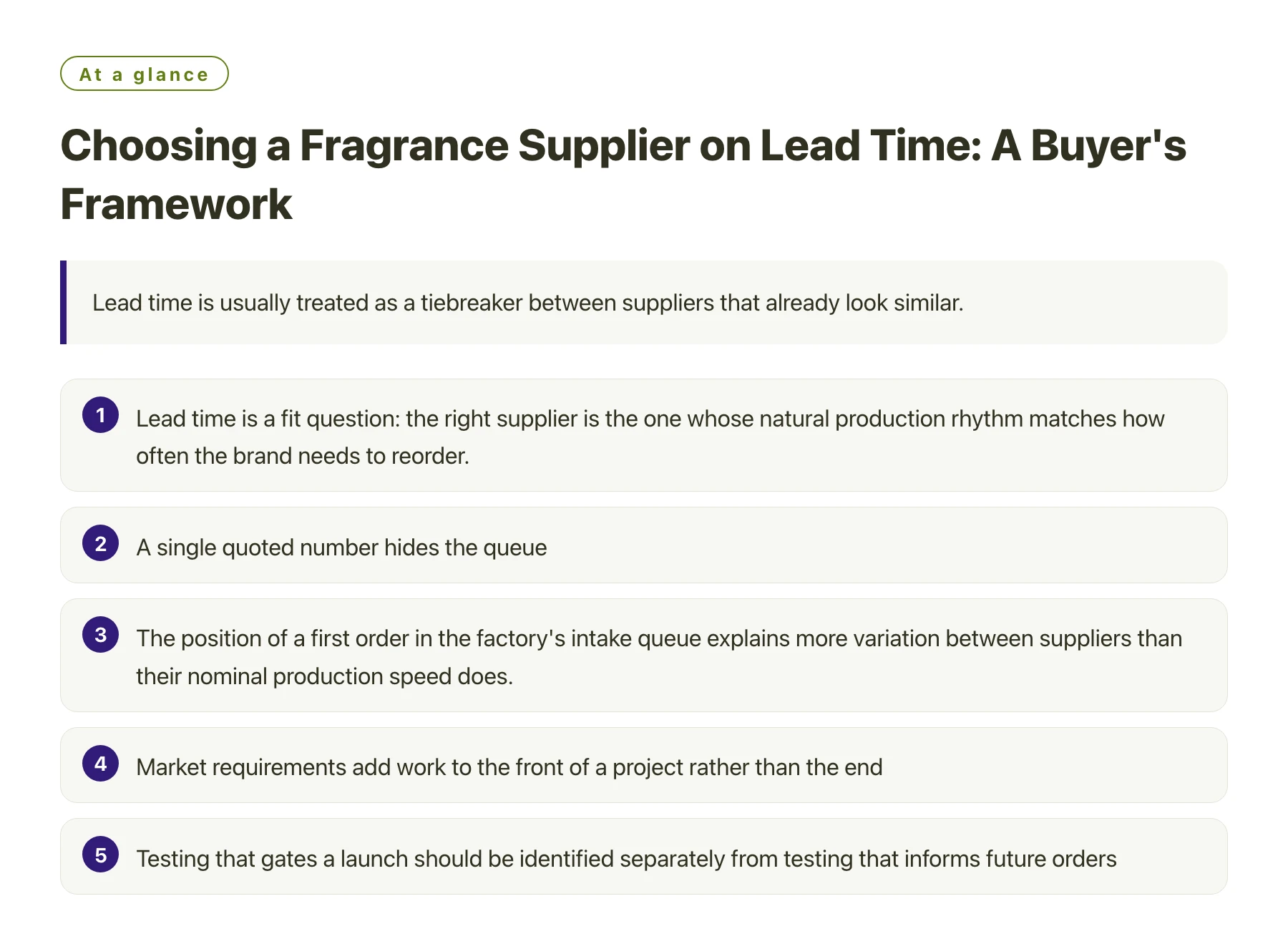
Key takeawaysLead time is a fit question: the right supplier is the one whose natural production rhythm matches how often the brand needs to reorder. · A single quoted number hides the queue, so the useful answer is a stage-by-stage range with the assumptions written next to it. · The position of a first order in the factory's intake queue explains more variation between suppliers than their nominal production speed does. · Market requirements add work to the front of a project rather than the end, so a supplier experienced with the destination market usually shortens the critical path [1]. · Testing that gates a launch should be identified separately from testing that informs future orders, because only the first belongs on the timeline [2].
An established brand adding a fragrance line usually has a merchandising calendar, a packaging supplier and a channel commitment before it has a scent. That makes the sourcing decision a scheduling decision as much as a commercial one.
This framework is written from a procurement perspective. It assumes the brand already knows roughly what it wants to make, and needs to choose between partners whose quotations look similar on paper.
Lead time as a fit question
Two factories can both produce an excellent fragrance and still be wrong for each other's customers, because lead time is a rhythm rather than a score. A brand refreshing a range twice a year can absorb a long development cycle. A brand that tests a scent online and reorders within weeks cannot, no matter how good the product is.
This is why the first comparison should be against the brand's own cadence. Map the number of projects planned per year, the smallest sensible reorder and the acceptable gap between an approved sample and shelf availability. Those three numbers eliminate some suppliers immediately, and that is a useful outcome rather than a lost option.
The same logic applies to a vegan specification. A supplier set up for vegan work will already have material records and an exclusion process, so the extra confirmation step is routine. A supplier treating it as a special request will place it in a queue of its own. A a fragrance manufacturer in Guangzhou that works with many export brands is likely to have seen the request before, but the specific evidence still has to be checked.
Where the brand sells into more than one market, add the markets to the comparison. Each market brings its own documentation and labelling work, and the supplier's familiarity with that work is part of the lead time.
Five questions that make the comparison real
- Ask for the stage breakdown, not the totalRequest development, sampling, testing, filling and freight as separate ranges. A supplier that can only give one number has not described its own process.
- Ask where a first order enters the queueA new project is scheduled around existing commitments. Ask how far ahead the line is booked and whether a first order is treated differently from a reorder.
- Ask what the ranges assume about your response timeMost quoted timelines quietly assume the brand replies within two working days. If your approval route takes a week, add that week to every stage that follows.
- Ask which tests gate the launchSeparate market-mandated testing from tests that improve the next order. Only the first group should shape the launch date.
- Ask what happens when the specification changesA change of fill size, pack or material lot after sampling is the most common cause of a slipped schedule. The change rule belongs in the comparison.
How lead time behaves by supplier type
| Supplier type | Where the time is spent | Usually the better fit when |
|---|---|---|
| Trading intermediary | Coordinating several production sites and re-sending information | The brand wants a narrow product scope and values a single point of contact over visibility |
| Single-site manufacturer | Development, compounding and filling in one schedule | The brand needs to see the process and to keep changes inside one production plan |
| Large integrated factory | Intake queue and internal scheduling between many orders | Volumes are predictable and the brand can plan several months ahead |
| Specialist small-batch producer | Manual production and personal attention at each stage | The launch is small, the pack is unusual, or the scent needs close iteration |
| Supplier with in-house perfumery | Perfumery time rather than sourcing time | The brief is complex and the brand expects several evaluation rounds |
The table is a starting point rather than a ranking. Its purpose is to make the brand name the kind of schedule it needs before it compares quotations.
Reading a promised lead time
A written timeline is a commitment only if its assumptions are written down too. The useful document names the start event and the end event precisely: does development begin when the brief arrives or when the brief is agreed? Does the quoted production period start at the approved sample or at the receipt of packaging components?
Buyers comparing suppliers often find that a shorter total hides a longer tail. A factory may quote a fast filling period while leaving packaging and freight outside the figure. Asking each supplier to mark which stages are inside the number makes the comparison honest.
It also helps to know which parts of the schedule are capacity-driven and which are process-driven. A description of how production capacity and lead times interact in practice usually makes clear that additional capacity shortens some stages and does nothing for others.
For a brand working across markets, the choice between a local partner and an export-focused one is often decided here. A perfume production partner in China will normally be familiar with export documentation and remote approval, which reduces the front-end work, but it also means the brand must be organised about approvals from a distance.
One last comparison point is worth adding: the cost of being wrong. A supplier that is a week slower but answers questions in writing is often cheaper overall than one that is faster and unresponsive, because the faster supplier's advantage disappears the first time a decision has to be chased.
Score suppliers on three columns, not one: the stage-by-stage range, the assumptions behind it, and the change rule if the specification moves. A supplier that scores well on all three is a schedule you can plan a launch around.
Sources
- European Commission: Cosmetics in the EU —— The European Commission's overview of EU cosmetics rules, including the responsible person, product information file and safety report requirements.
- SGS: Cosmetics, Personal Care & Household Testing —— Testing, inspection and certification services for cosmetics and personal care, including microbiological, stability and safety testing aligned with cosmetics GMP.
Frequently asked questions
What is a realistic lead time for a first fragrance order?
It depends on the number of sampling rounds, the testing required by the destination market and the shipping route, so a single figure is misleading. Ask for ranges by stage and add your own approval time to each stage that needs a decision from you.
Should a brand always choose the fastest supplier?
No. Speed is one variable among several, and a very fast quote often excludes work that has been moved elsewhere. The better question is whether the supplier's rhythm matches the brand's reorder cadence and channel commitments.
How does a vegan specification affect supplier selection?
It adds a material assurance requirement rather than a new production step. The supplier needs lot-level records and a substitution rule. A supplier that treats this as routine is generally a better fit than one that treats it as an exception.
How can a buyer verify a promised lead time?
By asking what the ranges assume, where a new order enters the queue, and which stages are excluded from the figure. Requesting these in writing, and comparing them across suppliers, reveals more than asking the same supplier for reassurance twice.
When should packaging be brought into the timeline?
At the same time as the scent direction rather than after the sample is approved. Component availability, decoration and compatibility testing all sit on the critical path, and starting them late is a common reason a well-managed scent project still misses its date.